

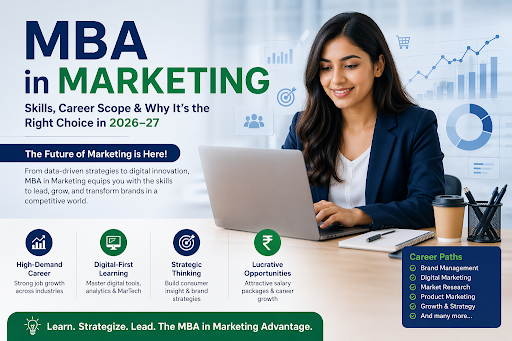
Marketing is no longer a support function. In 2026, it is the engine of growth for every organisation that needs to acquire, retain, and grow a customer base. The MBA that prepares you to lead that engine is not the same degree it was ten years ago.
Think about what a marketing professional's job looked like fifteen years ago. A brand manager at a consumer goods company would brief an agency, approve a TVC, run a print campaign, and track sales through distribution partners. The feedback loop was months long. The data was sparse. The craft was intuition-informed by research, expressed through mass communication.
Now, picture the same function today. The brand manager is looking at a real-time dashboard of attribution data across six digital channels. They are running A/B tests on ad copy, monitoring sentiment analysis from social platforms, briefing a performance marketing team on CAC targets, and approving a content calendar that feeds an algorithm-driven feed. The feedback loop is hours, not months. The data is overwhelming rather than sparse. The craft is now inseparable from technology, and the intuition must be disciplined by numbers.
This is the environment that an MBA in Marketing in 2026 is designed to prepare graduates for. Not the marketing of the past but the marketing of the present, which is already considerably more demanding than the discipline that most undergraduate business programmes were built to teach. The question this blog addresses is whether the online format of this degree can deliver that preparation genuinely, and whether the investment makes sense for where you want to go.
The hiring signal from marketing leadership roles in India in 2026 is specific and consistent: they want professionals who can think strategically and execute analytically. The combination is rarer than it sounds. A strategy without execution capability produces plans that do not land. Execution capability without strategic grounding produces tactical competence that cannot scale. The MBA in Marketing is specifically designed to build both dimensions simultaneously and to add the general management fluency that allows a marketing professional to work effectively across finance, operations, and technology functions.
The MBA marketing career scope in 2026 extends well beyond the traditional brand management and advertising roles that the degree was historically associated with. Digital commerce, content strategy, marketing technology, growth and acquisition, customer experience design, product marketing, and data-driven brand building are all now core marketing functions that require postgraduate-level capability to lead. The degree has not narrowed with the evolution of the field. It has widened.
Pattern Insight: In most cases, the marketing professionals who hit a ceiling at mid-career are not those who lack creativity or commercial instinct. They are those who cannot speak the analytical language that senior stakeholders, the CFO, the CEO, and the board expect from a marketing leader. They can articulate what a campaign achieved in marketing terms. They cannot translate it into business impact with the precision that justifies the budget. The MBA builds this translation capability. It is the difference between a strong marketer and a marketable CMO.
The hidden implication in the current hiring environment: the most valuable marketing profiles are those that combine domain expertise, deep knowledge of a specific function like performance marketing or brand strategy, with general management fluency. A pure specialist can execute brilliantly but cannot lead. A pure generalist can direct but cannot evaluate. The MBA in Marketing builds the connective tissue between the two, which is why it continues to be the most common qualification in senior marketing leadership roles.
The students and professionals considering an MBA in Marketing in 2026 typically arrive from one of three directions. The first is the undergraduate BBA or B.Com graduate who has a clear interest in marketing and brand-related careers, and who understands that the postgraduate degree will both deepen their knowledge and significantly improve their starting role quality compared to the undergraduate entry point. The second is the working professional with two to five years of experience in sales, marketing, digital agencies, or content, who has built tactical competence but senses the ceiling of their current qualification level approaching.
The third and perhaps the most interesting group in 2026 is the professional from a non-marketing background: the engineer who built a product and now wants to understand how to market it, the finance professional who wants to move into a commercial role, the journalist or content creator who wants to formalise their work into a strategic marketing qualification. For all three groups, the online format resolves the format problem without resolving the question that matters: Is this the right degree for where I want to go?
Contrarian Insight: One of the biggest gaps in how MBA in Marketing candidates evaluate their options is the assumption that the specialisation limits them to marketing roles. In practice, an MBA with a marketing specialisation produces a general management qualification with a strong commercial orientation. The analytical, communication, and strategy skills developed in the programme are applicable in product management, business development, entrepreneurship, consulting, and brand leadership. Students who understand this early build careers that are not constrained by the marketing department boundary; they move into commercial leadership roles that sit above the function.
Who is well-suited for an MBA in Marketing:
Who should think carefully before choosing:
The question of skills required for MBA Marketing is best answered by separating what the programme builds in two layers: the marketing-specific capabilities and the general management capabilities. Both are essential. A marketing professional who has the domain skills without the general management capabilities cannot lead cross-functional teams. One who has the general management skills without the marketing domain depth cannot credibly run a commercial function.
| Skill Category | Specific Skills | Where It Is Applied |
|---|---|---|
| Marketing Strategy | Market segmentation and targeting, brand positioning, competitive analysis, go-to-market strategy, portfolio management | Brand management, product marketing, CMO and VP Marketing roles, consulting |
| Consumer Behaviour and Insights | Psychographic and behavioural analysis, research design, ethnographic methods, data-driven consumer understanding | Brand strategy, customer experience, product development, and market research firms |
| Digital and Performance Marketing | SEO/SEM, social media marketing, email marketing, attribution modelling, performance measurement, marketing automation | Digital agencies, D2C brands, e-commerce, growth roles in tech companies |
| Marketing Analytics and Data | Campaign analytics, A/B testing, customer lifetime value modelling, marketing mix modelling, CRM analytics | Any data-driven marketing function is increasingly required at every level of seniority |
| Financial and Business Acumen | P&L understanding, marketing ROI calculation, budget management, business case development | Marketing leadership roles where commercial accountability is expected |
| Communication and Persuasion | Stakeholder communication, brand storytelling, sales and negotiation, executive presentation | Client-facing roles, agency work, commercial leadership, entrepreneurship |
| Product and Brand Management | Product lifecycle, brand architecture, pricing strategy, new product launch, brand equity measurement | FMCG, retail, e-commerce, D2C brands, marketing consultancies |
| Leadership and Team Management | Cross-functional team leadership, agency management, vendor relationships, performance management | Marketing manager and above roles where team and partner management are required |
The integration of Digital Marketing for MBA programmes has moved from a specialised elective to a core component of the curriculum in well-designed programmes, and this shift reflects a structural change in how marketing functions. Digital is not a channel strategy anymore. It is the operating environment within which every marketing strategy is executed and measured.
A strong MBA in Marketing curriculum now covers digital marketing not as a standalone module but as a dimension woven through the entire programme: digital consumer behaviour in the consumer insights module, performance marketing measurement in the analytics module, social commerce and platform economics in the strategy module, and marketing technology architecture in the applied elective. The graduate who exits the programme understanding how digital and traditional marketing work together and can move between them strategically is a significantly more capable professional than one who treats digital as a separate specialism.
The Online MBA Marketing Elective structure in well-designed programmes allows students to deepen in the specific marketing domain most aligned with their career goals. The elective choice is not a minor administrative decision. It is a career positioning decision that shapes the professional profile the degree produces.
| Elective Track | What It Covers | Best For | Career Destination |
|---|---|---|---|
| Brand Management | Brand architecture, brand equity, heritage brand management, brand revitalisation, brand extension strategy | Students targeting FMCG, consumer goods, retail, and luxury brand roles | Brand Manager, Category Manager, VP Brand at consumer companies |
| Digital and Performance Marketing | Growth hacking, performance channels, attribution, marketing automation, CRO, MarTech stack design | Professionals in or targeting digital agencies, D2C, and e-commerce growth roles | Head of Growth, Performance Marketing Lead, Digital Marketing Manager |
| Sales and Distribution Management | Channel strategy, sales force management, trade marketing, distribution network design, key account management | Students targeting FMCG field roles, B2B sales leadership, and distribution-intensive businesses | Sales Manager, National Sales Head, Key Account Manager |
| Services Marketing | Customer experience design, service quality management, relationship marketing, hospitality and financial services marketing | Students targeting BFSI, healthcare, telecom, and hospitality marketing | Customer Experience Lead, CRM Manager, Marketing Head in the services sector |
| Rural and Social Marketing | Rural consumer behaviour, village-level marketing, social marketing for behaviour change, bottom-of-the-pyramid strategy | Students interested in the development sector, rural FMCG, and social enterprise marketing | Rural Marketing Head, Social Impact Marketing Manager, Development Sector Roles |
| International Marketing | Export marketing, global brand management, cross-cultural consumer behaviour, international distribution | Students targeting MNCs, export firms, and international brand roles | International Brand Manager, Export Marketing Head, Global Marketing Analyst |
The elective choice signals something specific to hiring managers: not just that you have a marketing MBA, but that you have a marketing MBA calibrated toward a specific professional context. Students who treat elective selection as a strategic career positioning decision, choosing the track that aligns with their target sector and role type exit the programme with a more coherent and more hireable professional profile than those who choose based on perceived difficulty or scheduling convenience.
The career after MBA in Marketing follows a progression that is worth mapping at the role level, because the entry point does not fully reveal where the pathway goes.
| Career Track | Entry Role (0–3 yrs) | Mid-Level (4–7 yrs) | Senior Level (8+ yrs) | Key Sectors |
|---|---|---|---|---|
| Brand Management | Assistant Brand Manager, Brand Executive | Brand Manager, Senior Brand Manager | Marketing Director, VP Marketing, CMO | FMCG, D2C, retail, consumer durables |
| Digital Marketing | Digital Marketing Executive, Performance Marketing Associate | Digital Marketing Manager, Growth Lead | Head of Digital, Chief Growth Officer | E-commerce, D2C, tech, digital agencies |
| Market Research and Insights | Research Executive, Insights Analyst | Senior Research Manager, Consumer Insights Lead | Head of Insights, VP Strategy | Market research firms, MNCs, and FMCG |
| Sales and Commercial | Territory Sales Manager, Key Account Executive | Regional Sales Manager, National Account Manager | VP Sales, Chief Commercial Officer | FMCG, telecom, financial services, BFSI |
| Product Marketing | Product Marketing Associate, Go-to-Market Analyst | Product Marketing Manager, Category Lead | Head of Product Marketing, VP Product | Tech companies, SaaS, e-commerce |
| Consulting and Strategy | Business Analyst (Marketing), Strategy Associate | Marketing Consultant, Senior Strategy Manager | Principal, Partner, CMO at a consultancy | Management consulting, brand consultancies |
| Entrepreneurship | Co-founder, Chief Marketing Officer (startup) | Marketing Lead (growth stage) | CMO or CEO of a scaled venture | Startups, D2C, digital platforms |
Decision Insight: The career progression table above makes one thing clear: the MBA in Marketing is not a degree for a single job title. It is a qualification for a career trajectory. The entry roles are respectable; the mid-level roles are genuinely well-compensated and impactful; and the senior roles, CMO, VP Marketing, Chief Growth Officer, Chief Commercial Officer, are among the most influential and well-paid positions in any consumer-facing organisation. The students who reach those levels are those who combined the degree with deliberate domain development and genuine commercial curiosity. The degree opens the path. The professional builds it.
The MBA Marketing Salary India picture is more nuanced than the headline figures in placement brochures suggest, and understanding it with specificity is more useful than a single average number.
| Experience Level / Role | Salary Range | What Drives It Higher |
|---|---|---|
| Entry level (0–2 yrs) Brand / Marketing Executive | Rs. 4–8 LPA | Institution brand, city, sector (tech/FMCG pays more than traditional sectors) |
| Entry-level Digital / Performance Marketing | Rs. 5–10 LPA | Demonstrable platform skills, portfolio of campaign results, and tool certifications |
| Mid-level (3–6 yrs) Brand Manager / Marketing Manager | Rs. 10‘20 LPA | P&L ownership, team leadership, measurable brand equity or growth outcomes |
| Mid-level Growth / Digital Marketing Lead | Rs. 10‘20 LPA | Documented CAC/LTV improvement, multi-channel expertise, data fluency |
| Senior level (7+ yrs) Marketing Director / VP Marketing | Rs. 20–40 LPA | Cross-functional leadership, board-level communication, and company scale |
| CMO Large Organisation | Rs. 40–80 LPA+ | Reputation, revenue accountability, organisation size |
| CMO / Marketing Head Startup / Scale-Up | Rs. 20–40 LPA + ESOPs | In the company growth stage, equity upside is often more significant than cash |
| Consulting Senior Manager / Principal | Rs. 20–50 LPA | Firm tier, billable utilisation, specialisation, client calibre |
The salary data above reveals a consistent pattern: the gap between average and strong performers at every level is driven primarily by commercial accountability. Marketing professionals who can demonstrate the direct connection between their work and business outcomes, revenue generated, customer acquisition cost reduced, brand equity measured and grown, command significantly better compensation than those who can only describe the work without quantifying its impact. This accountability orientation is exactly what a well-designed MBA in Marketing is designed to build.
Future Projection: By 2027–28, three forces will reshape the marketing career landscape significantly. First, AI-augmented marketing execution: as generative AI takes over the production of standard content, advertising copy, and campaign variants, the premium will shift to the professionals who can direct, evaluate, and strategise around AI tools rather than produce without them. The marketer who understands brand strategy, consumer psychology, and business context will direct AI more effectively than the one who can only execute. Second, the rise of full-funnel commercial accountability: CFOs are increasingly requiring marketing leaders to demonstrate returns against financial metrics, not just marketing metrics. The MBA Marketing graduate who enters this environment with P&L fluency and financial communication capability will be disproportionately positioned. Third, the D2C expansion across India’s Tier 2 and Tier 3 markets: as digital commerce reaches deeper into the Indian consumer base, the demand for brand and growth professionals who understand non-metro consumer behaviour and vernacular digital channels will grow substantially.
The specific skill set that will be most valuable over this period: the combination of consumer psychology depth, data literacy, and strategic storytelling. These are not new capabilities, but they are the ones that AI cannot replicate and that organisations will increasingly pay a significant premium for. The MBA in Marketing, when pursued seriously and combined with real commercial experience, builds all three.
Our counselling team is ready to assist you at every step — click the button below to get started.
Need advice? Our experts are on WhatsApp 24/7—message us anytime!
