

There is a quiet reckoning happening inside organisations across India right now, and it begins with a question that ten years ago would have seemed too obvious to ask: why are talented people leaving?
The answer, in company after company, points to the same cluster of causes. Managers who were promoted for technical performance and given no training in people leadership. Cultures where compensation was calibrated but recognition was absent. Hiring processes that selected for skill and ignored fit. Onboarding that treated new employees as problems to be processed rather than as potential to be activated. These are not technology failures or strategy failures. They are people management failures, and they are costing organisations in ways that are now quantifiable, visible to boards, and impossible to ignore.
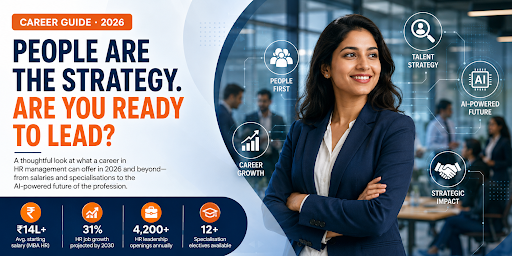
The consequence of this reckoning is that HR has stopped being a support function and started being a strategic one. The professionals being sought for senior people management roles in 2026 are not administrators. They are architects of organisational culture, analysts of workforce data, and strategic advisors to leadership on the most consequential decisions any organisation makes: who it hires, how it develops them, and what conditions it creates for them to do their best work.
This blog is for the student who sees that shift clearly and wants to build a career at its centre.
Three forces are converging to transform what HR professionals are expected to know, do, and deliver, and students who understand them arrive at the postgraduate decision with considerably more clarity than those who are still working from an outdated image of the function.
The first is the datafication of people's decisions. Workforce analytics, the systematic use of data to understand attrition patterns, predict performance, design compensation structures, and evaluate the impact of culture interventions, has moved from experimental to expected at most large and mid-sized organisations. HR professionals who cannot read and interpret people data are already at a disadvantage in most competitive hiring processes for senior roles. This is not a technology replacement story. It is a professional evolution story, and it is happening faster than most training programmes have acknowledged.
The second is the elevation of employee experience as a business metric. The connection between how people feel at work and what they produce has moved from intuitive assertion to measured reality. Organisations that have invested in understanding and improving employee experience through better onboarding, more meaningful feedback systems, clearer career pathing, and more deliberate culture design show measurable differences in retention, productivity, and customer outcomes. HR professionals who can design and operate these systems, not just administer them, are in genuine demand.
The third is the complexity of managing hybrid and distributed workforces. The shift in how and where work happens has created a set of people management challenges that have no established playbook: how to build cohesion across teams that may never be in the same room, how to maintain culture in a distributed environment, how to design performance systems that work fairly for both office-based and remote employees, and how to develop leaders whose teams exist primarily on screens. These are new problems that require new professional capability, and the programmes building that capability are the ones worth choosing.
The students drawn to HR as a postgraduate specialisation are more diverse than the stereotype suggests. Understanding which of the following portraits is closest to yours helps clarify what you actually need from the programme.
The People-First Professional Starting Out
Has always been the person others come to when they have a problem at university, in group projects, and in part-time roles. Has been told repeatedly that they are good with people, and has begun to understand that this informal competency can become a formal and well-compensated professional skill if built systematically. Choosing an HR postgraduate programme to give structure, credentials, and strategic depth to a natural aptitude. The risk to watch: aptitude without analytical rigour produces a pleasant colleague but a limited HR professional. The programme needs to build both.
The Manager Who Wants to Lead Better
Has been managing a team for two to four years and has experienced, firsthand, how much of leadership is actually people management: difficult conversations, performance gaps, team dynamics, hiring decisions, and motivation through uncertainty. Wants the formal framework that their MBA or undergraduate degree in another discipline did not provide. Not looking for theory. Looking for the conceptual vocabulary and structured approach that will make them better at something they are already doing and that will open the CHRO track they can now see clearly.
The Working Professional Making the Lateral Move
Has spent three to seven years in a business role, operations, sales, finance, or project management and wants to move into HR. Brings significant organisational experience and business context that most HR graduates entering from purely academic backgrounds lack. Needs the programme to provide the people management framework and HR-specific knowledge to make the transition credible. The cross-functional background, once credentialed, becomes a differentiator: business-side experience is one of the most valued qualities in senior HR roles, precisely because the function's strategic value depends on its ability to speak the language of the business it serves.
The common thread: the students who build the most meaningful HR careers are those who combine a genuine interest in human dynamics with the discipline to understand organisations analytically. People skills alone produce administrative professionals. People skills, business acumen plus analytical capability produce the strategic HR leaders that organisations are actively seeking and consistently struggling to find.
The comparison of MBA HR vs MBA Marketing is one that students encounter early and often, and it deserves a more direct answer than most guidance provides. Both are people-facing disciplines. Both require strong communication. Both can lead to senior, well-compensated careers. The difference is in the direction of the work.
HR points inward: The primary focus is on the people inside the organisation, how they are recruited, developed, engaged, compensated, and retained. The work requires empathy, structured thinking about systems and culture, comfort with complexity, and increasingly, analytical capability with workforce data. The satisfaction comes from watching people develop, teams, cohere, and organisations function better because the human architecture was designed well.
Marketing points outward: The primary focus is on people outside the organisation, customers, consumers, and markets. The work requires creativity, pattern recognition in consumer behaviour, comfort with ambiguity, and increasingly, digital and data fluency. The satisfaction comes from understanding why people make choices and designing communications and experiences that influence those choices at scale.
Students who choose HR for strategic reasons because they understand what the function does and why it matters build strong careers. Students who choose it because it seems more accessible than finance or more structured than marketing often find themselves in roles that are technically competent but personally uninspiring. The specialisation that fits your actual orientation toward people and problems will produce a better career than the one that seemed strategically optimal at the point of admission.
The MBA HR career scope that a programme unlocks is directly proportional to the depth and applicability of what the curriculum actually delivers. A well-designed postgraduate HR programme builds across five domains: Organisational Behaviour (understanding how individuals and groups function within structures, and how culture shapes behaviour); Human Resource Management (the full talent lifecycle workforce planning, recruitment, onboarding, performance management, learning and development, succession, and exit); Employment Law and Industrial Relations (the regulatory framework within which all HR decisions must operate understanding this is not optional for anyone managing people in India); Compensation and Benefits Design (the architecture of reward systems that attract, retain, and motivate); and Strategic HR and Business Partnering (how HR aligns with and serves the business strategy, rather than operating as a separate administrative function). The curriculum is the foundation. What the student builds on it determines the ceiling.
The elective layer is where professional direction gets encoded. An Online MBA HR Elective in Talent Analytics and Workforce Planning, Diversity and Inclusion Strategy, Learning and Development Design, or HR Technology and Digital Transformation allows a student to apply their foundational knowledge toward the specific domain where they want to build expertise. Students who choose electives as a coherent cluster of two or three that reinforce each other and build toward a specific role type arrive at interviews with a narrative that is considerably more convincing than those who selected based on what seemed interesting week by week. The elective choice is a career statement. It is worth making deliberately.
The learning-to-career translation, made concrete:
Where the Roles Are and What They Involve
The question of career after MBA HR maps across a wider organisational landscape than the traditional large-corporate-HR image suggests. Established entry points include: HR Business Partner roles embedded within specific business units, acting as the primary HR interface for a business leader; Talent Acquisition roles ranging from recruiter to TA manager at organisations with significant hiring volume; Learning and Development roles in companies with formal capability-building functions; Compensation and Benefits Analyst positions in organisations with complex reward structures; HR Operations and HRIS roles at companies implementing or managing people technology platforms; and Organisational Development roles at management consulting firms and internal OD teams. Beyond these, the startup ecosystem has created a distinct profile: the early People function hire, who builds the HR infrastructure of a growing company from near-zero, a role that is simultaneously demanding and professionally accelerating in ways that structured corporate roles rarely are.
What Compensation Looks Like Across the Arc
Discussing MBA HR salary in India honestly requires separating entry level from trajectory, because the figures that matter most are the ones three to five years into the career, rather than the ones on the first offer letter. At the entry level, HR roles for postgraduate candidates at private sector organisations typically range from Rs 35,000 to Rs 65,000 per month, varying by organisation size, sector, and city. At the three-to-five-year mark, HR Business Partners, Talent Acquisition leads, and Compensation Analysts at mid-to-large organisations reach Rs 80,000 to Rs 1,50,000 per month. Senior HR leadership HR Director, VP People, CHRO at established organisations command Rs 3,00,000 to Rs 8,00,000 per month and beyond. The professionals reaching the senior tier are not those with the longest tenures but those who combined people management credibility with business acumen, data literacy, and the ability to demonstrate that their work produced measurable organisational outcomes. The postgraduate qualification is the starting condition. What is built on it determines where the trajectory goes.
The Skills That Actually Separate Strong Candidates
When hiring managers describe what they want in HR postgraduate candidates, the skills for MBA HR that come up most consistently divide into three clusters. First is business understanding: the ability to read a P&L, understand how the business makes money, and connect HR decisions to commercial outcomes. This is the skill most often absent in HR graduates and most often cited as the differentiator at senior levels. Second is analytical capability: comfort with people data, the ability to interpret attrition patterns, build a compensation benchmark, or evaluate the ROI of a training programme using actual numbers. Third and most underrated is structured communication: the ability to present a people recommendation to a sceptical business leader in a way that is clear, evidenced, and decision-ready. Interpersonal warmth is assumed in HR candidates. These three skills are not. The students who invest in building them, alongside the formal curriculum, arrive at interviews in a different category.
The demand trajectory for HR professionals in India over the next three years is shaped by developments that are already visible and will intensify.
The formalisation of people analytics as a core HR function is the most significant structural shift. Organisations that invested early in workforce data infrastructure are now seeing measurable returns on attrition reduction, hiring quality improvement, and productivity growth. This is creating demand for HR professionals who combine people management knowledge with data fluency, a profile that is currently undersupplied relative to the demand being expressed in job postings and compensation packages. Students who build quantitative capability alongside their HR curriculum are positioning themselves for a market that will pay a premium for this combination for the foreseeable future.
The professionalisation of Diversity, Equity, and Inclusion as a formal HR discipline is the second significant development. As Indian organisations deepen their engagement with DEI, driven by a combination of global parent company standards, investor pressure, and genuine leadership commitment, the demand for HR professionals who can design, implement, and measure DEI programmes has moved from niche to mainstream. This is an area where postgraduate training that includes a dedicated elective, combined with applied project experience, creates genuine market differentiation.
The third development is the growth of the HR technology implementation and optimisation market. As more Indian organisations adopt HRIS platforms, ATS systems, and people analytics tools, the demand for HR professionals who can lead implementation, train users, and maximise the strategic value of these platforms is growing faster than the supply of people equipped to meet it. For students with both HR knowledge and comfort with technology systems, this represents a career lane with strong demand and limited competition.
Our counselling team is ready to assist you at every step — click the button below to get started.
Need advice? Our experts are on WhatsApp 24/7—message us anytime!
