

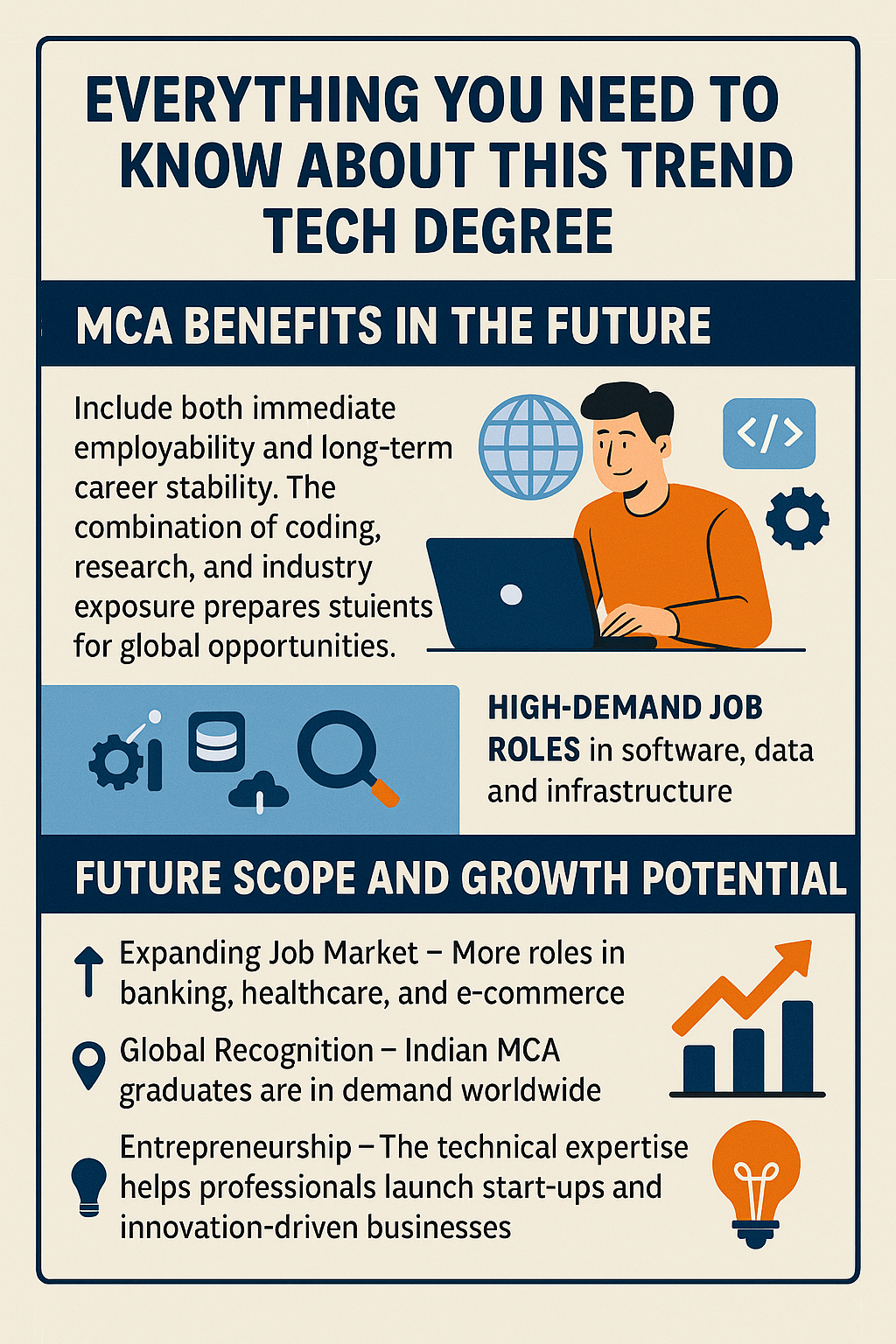
The Master of Computer Applications is one of the most preferred postgraduate degrees for students who want to build a strong career in the technology sector. As businesses across healthcare, banking, retail, education, logistics, and finance continue to depend on digital systems, the demand for skilled IT professionals is only growing.
This degree helps learners develop advanced knowledge of programming, software development, database management, cloud computing, artificial intelligence, cybersecurity, and system design. These skills make graduates ready for a wide range of roles in India and global technology markets.
For students planning a future-ready career in 2026–27, this postgraduate tech qualification offers strong academic value, practical exposure, and multiple career opportunities.
This is a career-focused postgraduate program that combines computer science theory with practical application. Students learn how to design, develop, manage, and improve applications, software systems, and digital platforms used by modern organisations.
One of the key MCA course benefits is that it builds both technical and professional abilities. Learners not only gain coding and software development knowledge but also develop problem-solving, analytical thinking, project management, and leadership skills.
These abilities are highly useful in solving complex IT challenges and working on real-world technology projects.
The course is usually completed in two years and is divided into four semesters. Some universities may offer a three-year structure for students from non-computer science backgrounds or may include bridge courses to help them build a strong technical base.
The curriculum generally includes a balance of:
This structure ensures that learners are prepared for immediate job opportunities as well as long-term career growth. The benefits of doing MCA also include exposure to both foundational and emerging areas of technology.
The syllabus usually covers a wide range of computer science and application-based subjects. These may include:
Through these subjects, students gain a well-rounded understanding of technology. This is one of the major benefits of the MCA course, as learners can explore different career paths based on their interests and strengths.
To apply, candidates usually need a bachelor’s degree from a recognised university with the required minimum marks. Many institutions also require Mathematics at the 10+2 level or during graduation.
Students from non-technical backgrounds may also be eligible, depending on the university’s admission policy. In such cases, bridge courses may be provided to help them understand basic programming and computer science concepts.
This flexibility is one of the MCA's advantages, as it allows students from different academic backgrounds to enter the IT field with structured learning support.
This postgraduate qualification offers several advantages for students who want to enter or grow in the technology sector.
With the growth of digital education, many students and working professionals now prefer an online MCA course. It allows learners to study without relocating or leaving their current jobs.
Online learning has become especially useful for professionals who want to upgrade their skills while continuing their careers. A UGC-entitled online degree from a recognised university can offer academic credibility along with learning flexibility.
Graduates can explore multiple career opportunities across technology-led industries. Some popular job roles include:
Technology is evolving quickly, and new-age roles are becoming increasingly important. Graduates can also explore opportunities such as:
These roles show the MCA benefits in future, especially as companies continue to adopt automation, AI, cloud platforms, and data-driven systems.
The salary after this degree depends on the learner’s technical skills, project experience, internships, certifications, location, and the type of company they join. Fresh graduates may begin with entry-level roles, while candidates with strong coding skills, cloud knowledge, AI exposure, or data analytics expertise can access better-paying opportunities.
In India, entry-level professionals can usually expect salaries in the range of ₹3 LPA to ₹6 LPA. With 2–5 years of experience, salaries can move to around ₹6 LPA to ₹12 LPA, depending on the role and organisation. Experienced professionals in specialised areas such as AI, cloud computing, cybersecurity, data science, and software architecture can earn significantly higher packages.
| Career Role | Approximate Salary Range in India |
|---|---|
| Software Developer / Software Engineer | ₹4 LPA – ₹12 LPA |
| Web Developer / Full Stack Developer | ₹3.5 LPA – ₹10 LPA |
| Data Analyst | ₹4 LPA – ₹9 LPA |
| Data Scientist | ₹6 LPA – ₹18 LPA |
| Cloud Engineer | ₹5 LPA – ₹15 LPA |
| Cybersecurity Analyst | ₹5 LPA – ₹14 LPA |
| Database Administrator | ₹4 LPA – ₹10 LPA |
| System Analyst | ₹5 LPA – ₹12 LPA |
| IT Consultant | ₹6 LPA – ₹16 LPA |
| AI / Machine Learning Engineer | ₹6 LPA – ₹20 LPA |
Graduates usually begin their careers in junior technical roles and gradually move into specialised or leadership positions. A common career path may look like this:
The career scope is not limited to IT companies. Skilled graduates are hired across multiple sectors, including:
The job market is becoming more skill-focused. Employers are giving higher value to candidates who can demonstrate practical ability through projects, internships, GitHub portfolios, certifications, and problem-solving skills.
Students who combine the degree with skills in AI, machine learning, cloud computing, cybersecurity, data analytics, DevOps, or full-stack development are likely to have stronger career prospects. For better salary growth, learners should not depend only on the degree but also build a strong portfolio of real-world projects.
Overall, the salary and career scope remain promising for students who continuously upgrade their skills and align themselves with emerging technology trends.
The program helps learners develop both technical and workplace skills that are highly valued by employers.
The future scope of this degree is strong because technology is now central to almost every industry. Banking, healthcare, e-commerce, education, manufacturing, media, and public services all require skilled IT professionals.
The MCA benefits in future include:
As digital transformation continues in 2026–27, professionals with advanced computer application skills will remain relevant across industries.
Choosing the right postgraduate degree depends on your career goal. Here is a simple comparison:
| Degree | Focus Area | Best Suited For |
|---|---|---|
| MCA | Software development, IT systems, applications, programming, and digital technologies | Students aiming for technical careers in IT |
| MBA | Business management, leadership, strategy, finance, marketing, and operations | Professionals seeking managerial or business roles |
| M.Sc IT | Research-based and theoretical understanding of information technology | Students interested in research, academia, or technical specialisation |
For students who want a technology-first career, the computer applications pathway is usually more suitable. For those who want business leadership roles, an MBA may be more relevant. For research-oriented learners, M.Sc IT can be a good option.
This program is suitable for:
In 2026–27, this postgraduate tech degree continues to be one of the strongest options for students who want to build a career in the IT industry. The benefits of MCA include strong technical learning, diverse job opportunities, global relevance, and long-term career growth.
Whether pursued through a regular classroom format or an online MCA course, the program helps learners gain practical skills in programming, software development, data, cloud, cybersecurity, and emerging technologies.
For students looking for a future-ready qualification with strong career potential, this degree can be a smart investment in the digital economy.
This program prepares you for higher-level roles by providing a strong foundation in technology and problem-solving. It helps you gain the expertise required to manage complex projects, lead teams, and work on innovative solutions across industries. Many organisations also prefer candidates with a postgraduate degree for leadership and specialised positions, giving you a competitive edge in the job market.
You will develop a blend of technical, analytical, and soft skills. These include programming abilities, project management, logical reasoning, and data handling expertise. The program also helps you build strong communication and teamwork capabilities, which are essential for working in collaborative, technology-driven environments.
The demand for technology professionals continues to grow as businesses rely more on digital systems and solutions. In the coming years, there will be increasing opportunities in areas like cloud platforms, data analysis, cybersecurity, and automation. This ensures that graduates will have a wide range of options to pursue both domestically and internationally.
While having a background in computer science or related fields is helpful, it is not always mandatory. Many universities offer foundation courses or preparatory modules to help students from other academic streams catch up with essential concepts before diving into advanced subjects.
The typical duration is two years, divided into four semesters. Some universities may offer an extended three-year track for learners from non-technical backgrounds, giving them more time to build foundational knowledge before advancing to complex topics.
Yes, many universities offer flexible learning options, including online classes and weekend sessions. These formats are designed for working professionals, allowing them to balance their education with job responsibilities without compromising either.
Our counselling team is ready to assist you at every step — click the button below to get started.
Need advice? Our experts are on WhatsApp 24/7—message us anytime!
