

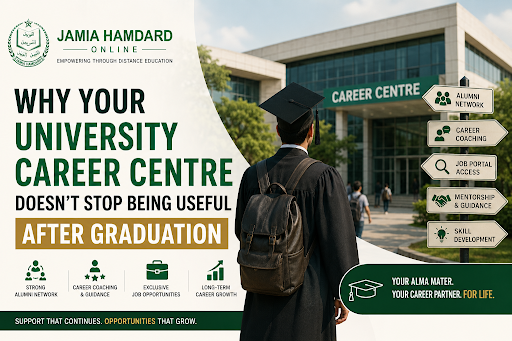
Graduation feels like a finishing line. Three or four years of coursework, assessments, and deadlines end, and most graduates walk away with the reasonable assumption that they are now on their own, that the institutional support that got them through the degree has served its purpose and closed its doors.
That assumption is expensive. Not immediately, and not visibly, but over time, it costs graduates opportunities they don't know they missed, connections they didn't know were available, and career guidance they didn't know they could still access. The university career centre, in most people's mental model, is a place you visit before graduation to polish your CV and panic about placement season. The idea that it remains a professional resource after graduation, sometimes for life, simply doesn't register.
The job market in 2025 is not forgiving of graduates who navigate it alone. Career paths are less linear than they were ten years ago. Switching industries, upskilling mid-career, and managing the anxiety of a slow job search all benefit from structured support. The question isn't whether you need that support; it's whether you know where to find it. For alumni of recognised institutions, a significant part of the answer is still on campus.
The range of online university career services available to alumni is wider than most graduates realise. Career centres at established institutions are not semester-bound services that shut down when you collect your degree. They are an ongoing alumni support infrastructure funded partly by the institution and partly by the long-term value they create in connecting graduates to employment outcomes that reflect well on the university.
The university placement support machinery, employer relationships, job portal access, and hiring event connections don't disappear after your final examination. In many cases, alumni have access to the same employer networks and exclusive listings that current students do, simply because maintaining those relationships serves the institution's long-term reputation. The graduate who uses this infrastructure is playing a different game from the one who doesn't.
What changes after graduation is the nature of the support. Career development after graduation shifts from broad preparation to specific navigation: you're no longer preparing for any job; you're working toward a particular role, a specific industry, or a deliberate career transition. The career centre's value at this stage is in providing structured support for that specific navigation, rather than the general placement-readiness focus of pre-graduation services.
Explore What's Available After Graduation
→ Career Advancement After Graduation
→ Business Career Opportunities
→ Technology Career Opportunities
There's a counterintuitive pattern in how graduates use career support: the students who use it most are those who need it least, the ones who are already organised, already networking, already prepared. The graduates who need it most, those who are confused about direction, anxious about their job search, or stuck between two paths, are the ones least likely to walk back through the career centre door after graduation.
Career coaching for graduates is not a remedial service for underperformers. It is a strategic thinking resource, a space where you can work through a career decision with someone who has seen hundreds of similar decisions play out, who knows the market context, and who can help you identify your blind spots before they cost you a year of misaligned effort.
One of the biggest gaps in how graduates approach the first two years after their degree is the absence of structured reflection. Most people move from graduation to job search to first role without ever clearly defining what they're optimising for: salary, growth, domain fit, location, or work culture. Employability skills development through career centre programmes forces that reflection in a structured way, which tends to produce better decisions and faster professional traction than simply applying to every job that looks remotely relevant.
Build the Skills That Accelerate Your Career
→ Management Career
Growth
→ Career Counselling Services
→
Professional Development Programs
Most graduates think of their university's alumni network as a passive asset, a list of people who went to the same institution, occasionally useful for a warm introduction. That framing dramatically undersells what a well-activated alumni network actually provides.
Alumni networking opportunities through a career centre are structured differently from organic professional networking. They're built around shared institutional context; you already have a common reference point with every person in the network, which makes the initial connection easier and the subsequent conversation more productive. An alumnus who graduated five years ahead of you in the same programme has navigated the career path you're about to start. That experience is worth more than a generic industry contact.
The professional networking for alumni infrastructure at established institutions curates events, mentorship matching, and alumni-specific discussion forums and is designed to convert that shared context into actionable professional relationships. A common pattern among alumni who advance quickly early in their careers is consistent, deliberate use of these networks rather than waiting for organic connections to materialise.
What separates a strong university alumni network from a nominal one is the quality of engagement it sustains over time. Universities that invest in alumni programming events, mentorship pipelines, and industry panels produce networks where the connections are active rather than dormant. For graduates, this means the network is worth engaging with now, not just when you need something specific.
Connect, Network and Grow
→ Leadership
And Management Skills
→ Job-Oriented Online
Courses
→ Career
Support For Graduates
Two of the most underused post-graduation career centre resources are also among the most immediately valuable: structured interview preparation and alumni-exclusive job listings.
Interview preparation support from a career centre is categorically different from reading interview tips online. It involves mock interviews with feedback calibrated to real hiring contexts, role-specific question preparation, and critically honest assessment of where your presentation is falling short. Most graduates who struggle in interviews don't have a knowledge problem; they have a communication problem. They know the content but haven't practised articulating it under pressure. Structured preparation closes that gap.
The alumni job portal is a resource that most graduates either don't know exists or access once and then forget. These portals aggregate roles that employers share specifically with alumni networks, sometimes before public posting, sometimes exclusively. A graduate who checks public job boards but ignores the alumni portal is leaving a material portion of their opportunity set unexplored.
Career fairs for graduates, as distinct from the placement drives organised for current students, are employer-connect events specifically designed for alumni in active career transition. The employers who attend these events are looking for experienced graduates, not campus freshers, which means the conversations are substantively different and more aligned to where a post-graduation job seeker actually is.
Access Tools That Give You an Edge
→ Online Learning For
Career Growth
→ Employability Skills
→ Digital Skills For Careers
Of all the post-graduation career centre resources available to alumni, structured mentorship is consistently the most underutilised and the most impactful. The reason it's underutilised is partly psychological: asking for guidance from a senior professional feels presumptuous to many graduates, particularly those early in their careers. The reason it's impactful is structural: a mentor who has navigated a career path similar to yours can compress years of learning into a series of direct, contextualised conversations.
Mentorship programs for alumni through career centres are structured to remove the social friction of cold outreach. The institution has done the matchmaking, connecting you with alumni whose professional trajectory aligns with your goals, and has created a context in which the mentoring relationship is expected and welcomed. All the graduate has to do is show up prepared, ask good questions, and follow through on what they discuss.
The compound effect of mentorship on professional growth after graduation is difficult to quantify but consistently reported by graduates who use it deliberately. Mentors open doors that aren't advertised. They provide candid feedback on career decisions. They share pattern recognition, 'I've seen this situation before and here's what typically happens,' that would otherwise take years of personal experience to develop. That acceleration is available to every alumnus with access to a functioning mentorship programme. Most simply don't use it.
Grow With Those Who've Been There
→ Networking Opportunities For
Students
→ Higher Education And
Career Success
One of the least-discussed dimensions of university career centres is their availability across multiple career stages, not just the immediate post-graduation period. Lifelong career support, the idea that your institution remains a resource whether you're two years or twenty years post-graduation, is a genuine offering at established universities, even if it's rarely communicated clearly.
For most graduates, the career path isn't linear. Industry shifts, company restructuring, personal priorities, and evolving skills all create moments of transition that benefit from structured support. Career transition support from a career centre, whether you're moving from one industry to another, returning to the workforce after a break, or navigating a step up to senior leadership, draws on the same institutional resources that supported your initial job search, now applied to a more complex professional context.
The online degree career opportunities available through a career centre are not a consolation prize for graduates of online programmes; they are the same infrastructure available to all alumni, regardless of how the degree was delivered. The credential, the alumni network, the career services, and the employer relationships are institutional assets. How you accessed the degree doesn't change your right to access what comes with it.
| Career Centre Service | What It Provides | Who Benefits Most |
|---|---|---|
| Career Coaching | One-on-one sessions to clarify direction, identify skill gaps, and build a career action plan | Recent graduates and mid-career alumni reconsidering direction |
| Interview Preparation | Mock interviews, feedback sessions, and role-specific question preparation | Alumni preparing for first roles or senior-level transitions |
| Alumni Job Portal | Exclusive listings shared with alumni roles are not always on public job boards | Graduates actively job-searching or exploring lateral moves |
| Mentorship Matching | Connection with senior alumni in your domain for guidance and industry insight | Early-career graduates and those entering new industries |
| Career Fairs & Events | Alumni-exclusive hiring events and employer connect sessions | Graduates looking for structured employer access |
| Skills Development | Workshops, certifications, and training programmes to close competency gaps | Alumni returning to the job market or pursuing career pivots |
Use the career centre actively if:
Don't wait until you need it urgently:
The job market over the next five years will be characterised by continuous disruption sectors evolving faster than degree programmes can track, roles emerging that don't yet have names, and skills becoming obsolete within five years of acquisition. In this context, a career centre isn't a one-time graduation resource. It's a recurring professional recalibration point.
Graduates who treat their career centre as a lifelong asset, checking in at career transitions, attending alumni events, and maintaining mentorship relationships consistently demonstrate better career agility than those who rely entirely on their professional network or personal initiative. The institutional perspective that a career centre provides is different from what you get from colleagues or industry contacts: it's broader, less biased by a single employer's perspective, and specifically designed to serve your interests rather than an organisation's.
The universities that invest most heavily in alumni career infrastructure are the ones that understand a simple truth: the value of a degree is not just in what happens during the programme. It's what the institution makes possible for the rest of the graduate's career.
Our counselling team is ready to assist you at every step — click the button below to get started.
Need advice? Our experts are on WhatsApp 24/7—message us anytime!
