

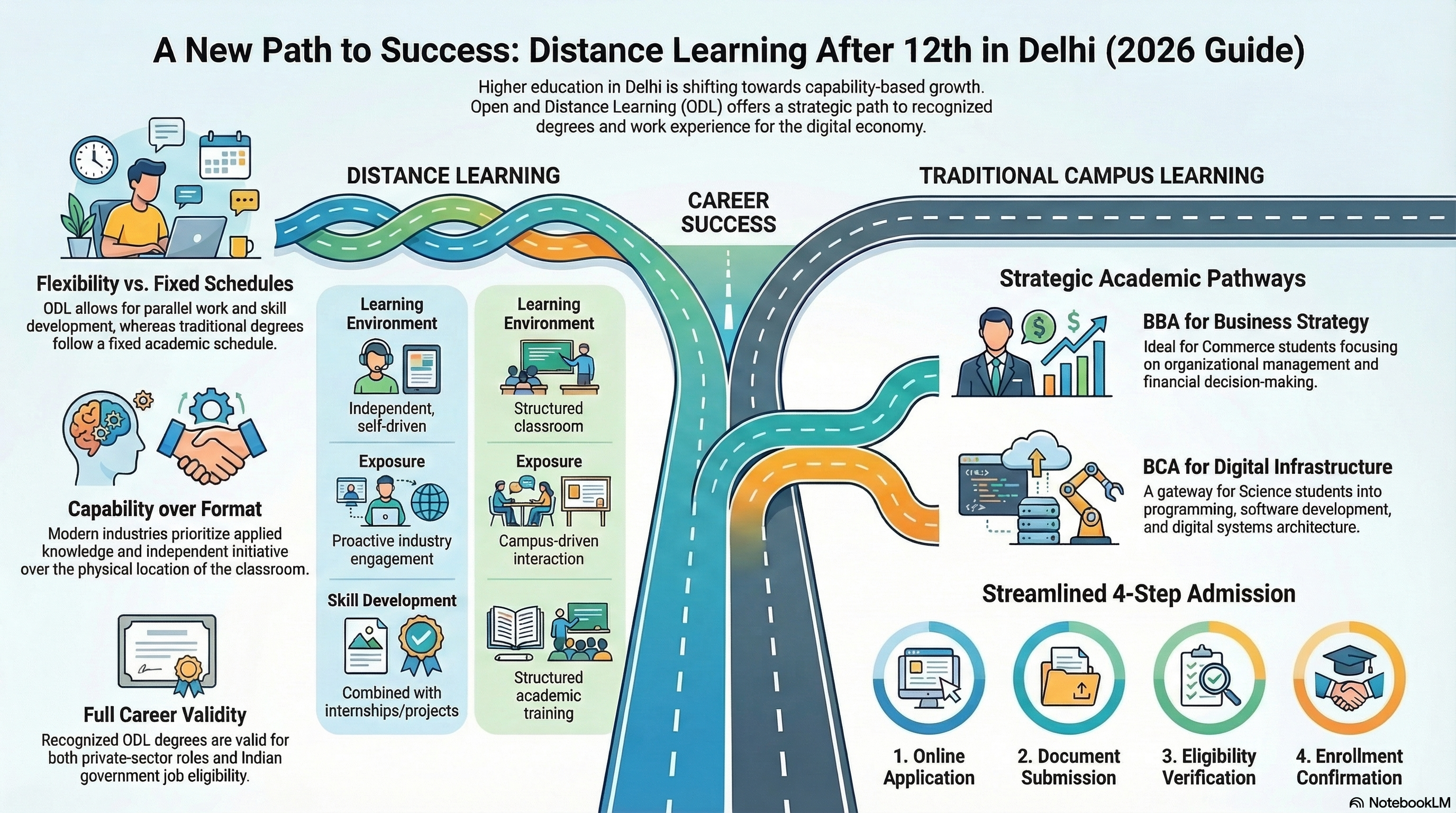
The journey after Class 12 has traditionally followed a predictable route: entrance exams, campus admissions, relocation to a university city, and a fixed academic schedule. For decades, this structure defined the start of professional life.
But the landscape of learning has changed. Students now navigate a world shaped by digital economies, evolving industries, and multiple learning pathways. In cities like Delhi and New Delhi, higher education is no longer limited to one format or one route.
This is why conversations around the best distance education courses after 12th are gaining attention. Open and Distance Learning (ODL) programs allow students to pursue structured university education while remaining connected to their local environment, family responsibilities, or early work opportunities.
ODL is not an alternative path because opportunities were lost. For many learners, it is simply another way of building capability.
Takeaway: Education is no longer defined by location. What matters today is the ability to learn, apply knowledge, and evolve professionally over time.
Distance education once carried the perception of being a secondary option. That perception is steadily shifting.
Industries today value capabilities and applied understanding more than the format through which learning occurs. Professionals often build careers through multiple educational routes: campus degrees, work-linked programs, and open learning systems.
This is where distance courses in Delhi have begun to play a meaningful role. Institutions that offer Open and Distance Learning create structured programs that allow learners to study recognised academic disciplines while building practical exposure in parallel.
The real shift is philosophical. A degree is no longer the final goal. It is a capability-building stage in a longer professional journey.
Students who pursue distance learning courses after 12th science, commerce, or arts are often doing something powerful: they begin learning while simultaneously exploring work environments, internships, entrepreneurship, or technical skills.
Takeaway: Career growth today is shaped by how knowledge is applied — not simply where it was studied.
The first degree after school quietly shapes the foundation of professional identity. It determines how students think, analyse, and engage with systems.
Across industries, three capabilities consistently influence career growth:
Programs offered through Open and Distance Learning can support these capabilities when they are aligned with real professional domains.
For example, many learners exploring distance courses after 12th commerce gravitate toward business and management fields. These programs introduce students to organisational thinking, business strategy, and operational decision-making.
Meanwhile, students considering distance courses after 12th arts often pursue fields connected to administration, communication, and social systems — areas that shape policy, media, and governance.
Science-oriented learners exploring distance learning courses after 12th science frequently move toward computing, data handling, and digital technology roles.
The choice of discipline is less about the degree title and more about the thinking framework it builds.
Takeaway: The first degree is not just education. It shapes the professional mindset a student carries into the workforce.
Open and Distance Learning programs are designed to provide structured university education through flexible learning systems. These programs maintain academic rigour while allowing students to learn without relocating or attending daily classroom sessions.
Two commonly pursued undergraduate programs in the ODL system include:
A BBA Degree introduces students to the functioning of organisations and markets. Learners explore areas such as:
Over time, this knowledge develops the ability to understand how businesses operate and how decisions influence growth.
Many students searching for distance courses after 12th commerce choose management programs because they connect academic learning with real-world organisational environments.
This is also why questions like: Can I do BBA online after 12th commerce in New Delhi? are becoming increasingly common. Students are recognising that management education can begin through multiple formats, including structured Open and Distance Learning systems.
Technology now influences almost every industry. A BCA Degree introduces students to the systems that power digital infrastructure.
Students typically learn:
For learners exploring distance learning courses after 12th science, computing education can become a gateway into technology-driven careers across sectors such as finance, healthcare, logistics, and digital services.
These programs focus less on memorisation and more on understanding how digital systems function in real environments.
Takeaway: The goal of an undergraduate program is not just subject knowledge. It is the development of thinking frameworks that shape professional capability.
One institution contributing to Open and Distance Learning in the capital region is Jamia Hamdard.
The university offers structured academic programs through its distance learning system, enabling students to pursue recognised degrees without relocating.
This is why searches around Jamia Hamdard distance degree have increased among students exploring higher education options in the region.
Institutions that operate within recognised regulatory frameworks ensure that the degree remains aligned with academic standards and national education guidelines.
For students and families evaluating distance learning, credibility and institutional trust remain critical factors.
Takeaway: In Open and Distance Learning, institutional credibility matters as much as the program itself.
A widely held belief is that classroom degrees automatically lead to better career outcomes. While campus environments provide structured interaction, career outcomes ultimately depend on capability development and applied learning.
Here is where a thoughtful comparison helps.
| Dimension | Distance Learning Degree | Traditional Campus Degree |
|---|---|---|
| Learning Environment | Independent, self-driven learning | Structured classroom environment |
| Flexibility | Allows parallel work or skill development | Fixed academic schedule |
| Exposure | Requires proactive engagement with the industry | Campus-driven exposure |
| Skill Development | Often combined with internships or projects | Structured academic training |
This comparison does not declare one format superior to another. It highlights something deeper: the learner's approach determines the outcome.
Students who actively build skills, explore industry exposure, and apply knowledge tend to grow professionally regardless of learning format.
Takeaway: Education format influences experience, but commitment to learning shapes career outcomes.
Students often ask: Are correspondence courses after 12th valid for government jobs?
In India, degrees earned through recognised Open and Distance Learning systems can be considered valid when they comply with national regulatory guidelines. This allows learners to pursue both private-sector careers and competitive examinations where applicable.
Similarly, many students ask: Is distance education valid in Delhi?
Yes — when the program is offered by a recognised institution operating under approved frameworks. What matters most is the recognition of the institution and the program, not merely the learning format.
The modern workforce increasingly values professionals who demonstrate:
These traits are often strengthened when students manage their learning journey actively.
Takeaway: Professional credibility grows from competence and persistence, not just academic format.
Students exploring programs such as a Jamia Hamdard distance degree often ask how admissions work in the Open and Distance Learning system. While processes may vary slightly by institution, they generally involve:
The process is designed to ensure that students who have completed Class 12 can begin their undergraduate journey through recognised academic systems.
Higher education today is no longer defined by a single path. Some students pursue campus programs. Some begin with distance learning. Others combine education with early work exposure.
What ultimately shapes a career is not the format of the first degree, but the consistency with which knowledge is pursued and applied. Students exploring the best distance education courses after 12th are often asking a deeper question: Will this path still lead to opportunity? The answer lies in how the learner uses that path.
Education is not a straight road. It is a system of evolving possibilities. And for those who remain committed to learning, growth, and capability-building, every legitimate pathway can lead to a meaningful future.
Final Takeaway: The path you choose matters less than the commitment you bring to it. Distance learning offers flexibility; your dedication determines the outcome.
Courses like BBA, B.Com, and BCA are commonly chosen by commerce students. These programs build understanding of business, finance, and digital systems.
Yes. Distance education is valid if the program is offered by a recognised university under approved academic regulations.
Yes. Students who have completed Class 12 from a recognised board can apply for BBA programs offered through online or Open and Distance Learning.
Science students often choose BCA or technology-focused programs, which help build knowledge in programming, software, and digital systems.
Yes. Degrees earned through recognised distance learning universities are generally accepted for government job eligibility.
The process usually involves filling the application form, submitting documents, paying the fee, and confirming admission based on eligibility.
Both have value. Regular BBA offers classroom learning, while distance BBA provides flexibility to study while gaining other experiences. The better option depends on the student's goals.
Our counselling team is ready to assist you at every step — click the button below to get started.
Need advice? Our experts are on WhatsApp 24/7—message us anytime!
